


Slavic Warrior Women, pt. 16: Nastasia Korolevichna

Link to my full dissertation, Amazons, Shieldmaidens, and Daring Polianitsy: Slavic Warrior Women in Medieval Literature and Folklore: https://libraetd.lib.virginia.edu/public_view/r207tq787
Time for Slavic Warrior Women, part 16! Today we’ll begin our last section of case studies (there are just four more after this, then we’ll wrap up the series). Today’s topic is Nastasia Korolevichna.
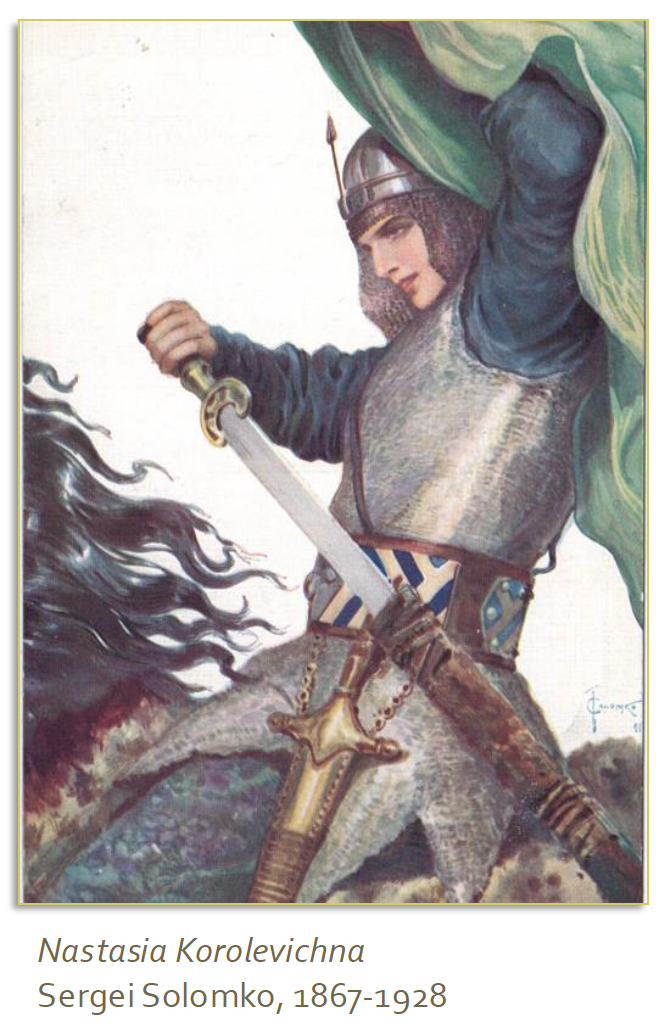
Nastasia Korolevichna, heroine of the popular bylina “Dunai,” is a warrior princess whose military endeavors have nothing to do with her royal status. She rules no kingdom, she leads no armies to protect her country, and while she does marry, her husband is no prince. Furthermore, her marriage ends in swift tragedy. The bylina in which Nastasia appears is one of the most popular, existing in over a hundred variants, and it explains the origins of the river Danube.[1] One of the earliest recorded variants, which became the dominant version, was performed by Avdotia Koppalina and captured by Grigoriev in 1899, though the narrative itself considerably predates its recording. Koppalina’s two-part rendition describes the bogatyr Dunai’s initial trip to Lithuania, during which he enjoys a romantic relationship with Nastasia, as well as the tragic aftermath of his second trip.[2] Some Ukrainian variants give her name as Nepra, but most often the polianitsa is Nastasia, the eldest daughter of a foreign king, a fierce and independent maiden who is “always roaming and looking for a fight.”[3]
Like all byliny, the hero’s journey—for, of course, the hero of the tale is a man—begins at the court of Prince Vladimir. In this instance, Vladimir is lamenting his lack of wife, and so requests if any in attendance know of a worthy woman. The bogatyr Dunai Ivanovich, who previously spent either three, nine, or twelve years serving at a foreign court, offers up the names of the two foreign princesses. Most often this foreign court is in Lithuania, but in a few variants, Poland.[4] Dunai describes both sisters’ beauty, but cautions Vladimir, “The first daughter, Nastasia Korolevichna, / her face is white as snow, / her brows are darker than sable, / her eyes are clear as a falcon’s, / only, my sun, you would not be able to control her.”[5] Instead, he proposes that Vladimir should wed Nastasia’s younger sister, usually named Apraxia, who shares her beauty but not her warlike proclivities. Vladimir agrees and subsequently dispatches Dunai to woo Nastasia’s gentle younger sister, by force if necessary, and offers Dunai the might of his armies to accompany him on his bride-taking mission. However, in lieu of an army Dunai requests only the presence of fellow bogatyri Dobrynia Nikitich and Alyosha Popovich.
Faced with the might of three Russian bogatyri, the Lithuanian king grants his approval of the marriage, and so Apraxia accompanies Dunai back to Kyiv. However, while riding through the obligatory ‘open field,’ the Russians spy a rider in the distance. Not knowing whether or not the rider is friendly, they determine that if he proves to be a true Russian bogatyr, they will escort him to Vladimir’s court; if he proves to be an enemy, then he will answer for it in battle.[6] When the unknown rider catches up with the bogatyri, Dunai challenges him, and so the two duel, first astride their horses with various weapons, and then finally hand-to-hand on the ground. Dunai eventually gains the advantage and demands the foreign warrior’s identity. However, once the warrior speaks, chiding Dunai’s lack of recognition, Dunai finally realizes that he has bested none other than Nastasia Korolevichna. Having proven worthy of each other through combat, the polianitsa and bogatyr decide to marry. Thus, when the party finally returns to Kyiv, Nastasia and Dunai join Apraxia and Vladimir in a double wedding.
Typical of feasts in legendary Rus’, the wedding celebration involves much merriment, drinking, and most importantly, boasting. Nastasia participates enthusiastically in the boasting, which violates the expected norms of femininity. In most variants, she brags of her archery prowess, citing her ability to split an arrow down the center along a knife’s edge.[7] Some variants have her shoot an arrow from a great distance through a golden ring, furthering the wedding imagery, and in a later variant collected in the twentieth century, she anachronistically uses a rifle, thereby threading the ring with a bullet instead of an arrow.[8] Regardless of her choice of weapon, Dunai is ashamed by his new bride’s boasts and so challenges her to prove her claim, which she readily does. When he fails to duplicate her feats, Dunai turns his weapon against Nastasia. She argues with him not to kill her, confessing that she is pregnant, sometimes with twins, sometimes with a single child. Sometimes she suggests alternate punishments, or else requests that he at least delay her execution until after she has given birth.
Nevertheless, Dunai cannot bear the realization that his wife is the superior warrior, and so in a blind rage he lets his arrow fly. Pierced through the heart, Nastasia dies instantly. Dunai then cuts open her chest and discovers that she was, in fact, pregnant. In a minority of variants, Dunai shoots Nastasia not through the heart, but through the womb, prolonging his wife’s suffering while hastening their child’s death. In either case, the unborn child is described in accordance with imagery traditionally used in Russian folklore to indicate a heroic or miraculous birth: the baby has silver legs, golden arms, and stars at his brow.[9] Overcome with grief at the loss of both his bride and child by his own hand, Dunai falls upon his knife. From his blood flows the river Danube, and from Nastasia’s flows another river.
In another early variant of “Dunai,” recorded by Gilferding in 1871, Nastasia Korolevichna and Nastasia Mikulishna are one and the same, with the Lithuanian king thus named as Mikula.[10] Performed by a female singer, D. V. Surikova, this variant differs from the primary version that became popularized later in several key ways. In Surikova’s version, when Nastasia follows the bogatyri after they take her sister, Dunai is aware immediately that his opponent is a woman, though he still does not recognize her as Nastasia. Dunai sends Dobrynia Nikitich ahead to keep escorting her sister to Kyiv while he stays behind to face the “daring polianitsa.”[11] Another key difference is the length of their marriage. In most variants, the fateful boasting occurs immediately after they wed, but in Surikova’s version they live together for three years before attending another of Vladimir’s feasts. At this feast, Dunai initiates the competition by first bragging about how he secured a “white swan” for himself as well as the prince.[12] Nastasia counters that he may have done so, but that she could shoot a flaming arrow through a golden ring he held without hurting him, while if he attempted to perform the same feat, he would surely kill her.[13] Unfortunately for Nastasia, her prophecy comes to pass, and Dunai’s inability to duplicate her feat results in her death. The distinction here is that in Surikova’s rendition, Dunai does not intend to kill his wife, so he does not act out of vengeance. Dunai’s folly is in thinking he could be Nastasia’s equal. A final difference between Surikova’s version and what came to be the dominant narrative is that no mention is ever made of a miraculous pregnancy.
As yet another reflection of mortal punishments for unruly women in literature, Nastasia’s tragic fate is a natural consequence of not submitting to her husband. Her persistent independence after her marriage merits Dunai’s wrath, because it amounts to a betrayal of his rights as her husband. Therefore, while she was at first an equal companion to the hero, as soon as she disagrees with him and then bests him—worse still, she does so publicly—she gives Dunai no choice but to punish her.[14] A husband’s jealousy in a bylina amounts to guaranteed death. The pattern of a heroine dying when she ceases to be useful to the hero, and dying at the hand of the hero himself if she displeases or betrays him, is a common trope in Russian byliny. However, despite folkloric norms justifying Dunai’s response to Nastasia Korolevichna’s public display of superiority, Dunai regrets his impulsive actions, hence his suicide; it is Dunai’s fate that marks the bylina as a tragedy rather than Nastasia’s.[15]
In telling a creation story, this bylina straddles the line between folktale and myth. “Dunai” explains the origins of the Danube, which among European rivers is second in length only to the Volga. As a river in the real world, the Danube reigned supreme as an important trade route not only for Kyivan Rus’, but for the Scythians in the centuries before them and for many other peoples in the thousands of years before that, cutting across central Europe and emptying into the Black Sea.[16] As a river in the legendary world of folklore, the Danube also holds a special place. The river figures in the mythology and folklore of many cultures, with legendary heroes from Rome to Scandinavia navigating its waters.[17] Herodotus even emphasizes the significance of the river, at that time known to the Greeks as the Istros or Ister, in his descriptions of Scythian geography.[18] However, Slavic folklore in particular regarding the Danube—as evident in Dunai and Nastasia’s star-crossed romance, among other tales—equates the themes of marriage and death, perhaps indicative of a prehistoric association between the Danube and fertility cults.[19]
Rivers, as flowing earthly waters, likely held sympathetic significance with fertility concepts in Slavic paganism.[20] Some Russian folklorists suggest that the death of Dunai and Nastasia’s unborn son is a remnant of child sacrifice to appease a water deity.[21] Given the evidence among the pagan Slavs for not only human sacrifice in general, but specifically self-sacrifice, it is also possible that the entire narrative of “Dunai” reflects a pagan ritual, perhaps in which sacrifices were made—human or otherwise—to a body of water.[22] If that were the case, the underlying events of the bylina would significantly predate its supposed setting of medieval Kyiv, suggesting the inclusion of a polianitsa in a key narrative role reflects an earlier reality during which such warrior women existed. The Danish historian Saxo Grammaticus viewed strong, warlike women as an unfortunate occurrence of the pagan past; Nastasia Korolevichna would certainly fit the bill.
Though Dunai is the stated hero of the bylina, though his name appears in the title, and though it is his death that marks the bylina as tragic, the bulk of the heroic action in the plot belongs to Nastasia Korolevichna. Anonymously and alone, she confronts three bogatyri who are, in some interpretations, kidnapping her younger sister. While she only duels one of them, she holds her own for multiple rounds, and only once the fight goes to the ground does she yield, and even then, only after a fierce struggle. Considering the rest of her martial achievements and the parallels between polianitsy and Scythian cavalry, one could assume that, had the fight remained on horseback, Nastasia would have won. Maybe she loses intentionally, in the spirit of a ritual Scythian marriage duel. Later, at the wedding feast, she continues to hold her own among the men, participating as any other hero in the rounds of boasts. It is only her gender which designates her boasts unacceptable. Furthermore, unlike the rest of the heroes present, Nastasia makes good on her claims, performing feats of archery none of the men can replicate, including her new husband. Yet, for all her heroic action, for all her valor and ability, her reward is death. She is uncontrollable, undomesticated; relegated to the realm of folklore and without a historical imperative insisting otherwise, Nastasia’s story could end no other way.
Next installment, I’ll talk about the polianitsa Vasilisa Mikulishna!
Citations:
[1] Bailey and Ivanova, trans. and eds., Anthology of Russian Folk Epics, 188.
[2] M. V. Novikov, ed., “Primechaniia k tekstam,” Arkhangel’skie byliny i istoricheskie pesnii sobrannye A. D. Grigorevym v 1899-1901 (Tropa Troianova, 2002): 656.
[3] Bailey and Ivanova, trans. and eds., Anthology of Russian Folk Epics, 192.
[4] Novikov, “Primechaniia k tekstam,” Arkhangel’skie byliny, 653.
[5] A. M. Astakhova, ed., “Dunai,” lines 70-74, Byliny Pudozhskogo kraia (Gosoudarstvennoe izdatel’stvo K-FSSR, 1941): “Перва дочь — Настасья королевишна, / Лицом она как белой снег, / Брови у ей чорна соболя, / Глаза у ней ясна сокола, / Только, солнышко, не владать тебе будет ей.”
[6] Astakhova, “Dunai,” lines 194-195: “Если руськой бога́тырь — звать к Солнышку на почестен пир, / А если неверной бога́тырь — то с ним поотведатце.”.
[7] Bailey and Ivanova, trans. and eds., Anthology of Russian Folk Epics, 198.
[8] Kaplun, “Archetype of the Maiden Warrior,” 311.
[9] Bailey and Ivanova, trans. and eds., Anthology of Russian Folk Epics, 199.
[10] D. V. Surikova, “Dunai,” No. 139), Onezhskie byliny (Izdatel’stvo Akademii nauk SSSR, 1949).
[11] Ibid. Dunai’s parting words to Dobrynia: “А’ще ль я жив буду, поеду за поляницей за удалою,” line 174.
[12] Ibid. Dunai says, “Я-ка в зе́млях ляховинскиих, / Как сам женился, да царя женил, / Вытащил две белые две лебеди,” lines 234-236.
[13] Ibid. Nastasia declares, “А тебе не стрелить стрелочки каленой, / Чтобы попасть в колечко золоченое: / Ты у́бьешь Настасью Микуличну,” lines 247-249.
[14] Savchenko, “Integratsiia zhenskikh tipov v kontsepte ‘Geroid’,” 156.
[15] Bailey and Ivanova, trans. and eds., Anthology of Russian Folk Epics, 191.
[16] Beattie, Danube: A Cultural History, xiii.
[17] Ibid., ix.
[18] Herodotus, Historíai, 4.48.
[19] Petukhov, “Arkhaicheskie sledy matrimonial’nykh otnoshenii,” 65; S. Iu. Khar’kova, “Gidronim Dunai v severnorusskikh bylinakh,” Istoriia i kul’tura. Vypusk 14, no. 14 (2016): 98.
[20] Francis Conte, “Paganism and Christianity in Russia: ‘double’ or ‘triple’ faith?” Christianization of Ancient Russia: A Millennium 988-1988, ed. by Yves Hamant (UNESCO, 1992): 210.
[21] T. V. Tadevosian, “Chelovechskie zhertvoprinosheniia i kannibalism (na materiale nartskogo epos ai russkikh bylin,” Eposovedenie 1, no. 9 (2018): 104.
[22] Sergey Averintsev, “The baptism of Rus’ and the path of Russian culture,” Christianization of Ancient Russia: A Millennium 988-1988, ed. by Yves Hamant (UNESCO, 1992): 139.


Comments