


Slavic Warrior Women, pt. 15: Daring Polianitsy
- Melissa Ivanco-Murray

- 2 hours ago
- 17 min read
Link to my full dissertation, Amazons, Shieldmaidens, and Daring Polianitsy: Slavic Warrior Women in Medieval Literature and Folklore: https://libraetd.lib.virginia.edu/public_view/r207tq787
Time for Slavic Warrior Women, installment number 15! Today I’ll give you a quick introduction to a complicated topic: Russian folklore and the warrior women who populate it. Specifically, we’ll be talking about (in very general terms) the difference between byliny (epic folk ballads) and skazki (fairy tales), and a brief overview of the polianitsy. This is by necessity a longer post, but it is a topic with which I expect you, my fabulous audience, are least familiar. Hence, I’m devoting a bit more space to it before diving back into warrior women case studies of individual polianitsy.
Thus far, all of the individual women I have discussed held key leadership roles, and all except Vlasta were born or married into royalty. Even the skjaldmeyjar in Norse sagas came predominantly from the noble class. Many of the strong women remembered by history were not just warriors, then, but warrior queens, obligated to understand military command beyond the requirements of peacetime leadership. While the archaeological record supports the existence of warrior women at elite levels of society from ancient times through the medieval period, not all women who donned armor and took to the battlefield were rulers. The spectrum of wealth with which armed women were buried, from simple arrowheads and axes to elaborate jewelry and crowns, likewise supports this notion. So, where are all the non-royal warrior women in literature? Ancient and medieval authors seldom deigned to immortalize their stories in written record, but the narratives of ordinary warrior women—to the extent any women transgressing social norms could be considered ordinary—survived in oral literature: in fairy tales, epic ballads, and other subgenres of folklore.
Of course, folklore also contains numerous examples of princesses and queens, some of whom did indeed wield weapons. Yet, as the name implies, common folk often populate folktales.[1] Oral literature fell under the purview of every socioeconomic class, from the illiterate peasant up to the monarch himself. Children, even princes and princesses, listened to their nurses recite fairy tales about dragons, deathless sorcerers, witches, and youngest sons who became tsars.[2] Therefore, it is no surprise that the protagonists of folktales likewise represent all levels of society. Warrior queens Mar’ia Morevna and Sineglazka may rule over distant fairytale kingdoms, but they are also accompanied by all-female druzhiny, contingents of loyal soldiers or guards, who would not necessarily have been noble by birth. In some variants of their tales, Vasilisa and Nastasia Mikulishna are the daughters of a Lithuanian king, but in other versions, their father is a plowman. Perhaps, like the Czech Přemysl, the roles of king and plowman are not mutually exclusive, at least as far as folklore is concerned.
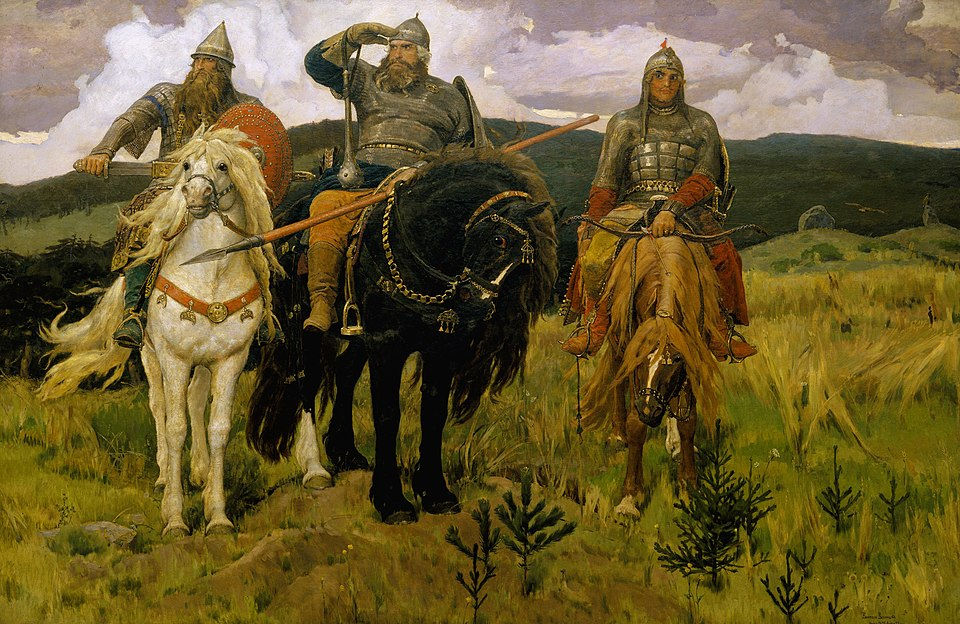
Regardless of their social status at birth, medieval Slavic warrior women, known as polianitsy, appear in several subgenres of Russian folklore, predominantly in byliny, or epic folk ballads, as well as skazki, or fairy tales. Little studied beyond their surface role in folktales, polianitsy are warrior women with heroic traits who appear in Russian folklore and correspond to the male heroes known as bogatyri. Some folklorists consider polianitsy stock characters since they fulfil specific, repeated roles in byliny.[3] While the most recognizable polianitsy in byliny can be princesses, they never rule; in contrast, the polianitsy in skazki are usually queens. However, polianitsy are always foreigners, typically arriving in Kyiv from Lithuania, Poland, or some distant, semi-magical maiden kingdom. Like the Amazons and other Scythian nomads, polianitsy are closely associated with horses and bows. Epic folk ballads depict them fighting as cavalry and performing impossible feats of archery, besting their male opponents. In fact, some scholars have been drawing parallels between the polianitsy of folklore and the Amazons of ancient literature since the early twentieth century. The theme of Russians as the descendants of Scythians also traces back at least to the reign of Catherine II, who often stylized herself as the war goddess Athena or Minerva, and under whom Russian scholars proposed a Scythian origin for their people.[4] Nevertheless, the vast majority of scholars dismiss the polianitsy as pure fiction.
Although some folktales refer to warrior women as bogatyrki, I will exclusively use the term polianitsy for consistency and to distinguish them from the male heroes known as bogatyri. Notably, polianitsy by other names appear in the folktales of other Slavic nations besides Russia as well as non-Slavic ethnic communities residing within present-day Russia, including indigenous Siberian tribes who maintained an oral tradition of warrior women akin to Amazons who also likely trace back to historical Scythians.[5] Russian folklore provides the names of twelve polianitsy in total, but as with the named Amazons, most do not possess their own narratives, and significant overlap in the narratives of those who do complicates their differentiation.[6]
The mutability of oral literature results from its performative and collective nature. We can usually attribute written literature to a single author, even if that author remains unknown, but there is no one author of a folktale; instead, we have storytellers, singers, performers, those who heard the tale from another and made their own edits, and so in the vast majority of cases, we cannot trace a folktale to a specific, individual creator.[7] Moreover, rarely is storytelling one’s primary profession, especially regarding skazki.[8] The oral method of preserving and disseminating folklore (i.e., performance) also begets several impediments to scholarship. Because of the high number of variants of any folktale—some of the more popular byliny have been recorded in at least two versions and hundreds of variants—it is impossible to pinpoint an original narrative.[9] Even repeat performances of the same tale by the same singer differ, creating more variants based on each individual performance.[10] As a result, scholars have collected more than 4000 variants of byliny alone.[11] As soon as collectors and anthologists begin to record those variants, however, some contamination naturally occurs, with live performers drawing from the written texts in addition to or in lieu of oral traditions, contributing to the development of one dominant, hybridized version of a particular tale.[12]
Certainly, some tales have been so oft repeated that they become ingrained in the minds of not only the performers, but also the audiences, and therefore collective memory and correction produces a dominant, consistent narrative.[13] However, the specific language of folklore also contributes to the preservation of certain versions. In both byliny and skazki, performers make use of repetition through stock epithets (the hero always rides a “good horse;” the Russian bogatyr always has “golden curls”), stock locations (the feast at the court of Prince Vladimir, the land “beyond thrice nine kingdoms”), and stock characters (the ideal princess, the evil sorceress, the kidnapping dragon).[14] Tatars and Lithuanians appear as stock enemies for the bogatyri to fight, and Prince Vladimir stands in for any ruling prince, not to a specific ruler like Vladimir I or Vladimir Monomakh, though he is sometimes thought to represent one of them.[15] The performative aspect of byliny and skazki precludes unique, detailed descriptions of places or people, so the use of stock language streamlines the narrative and allows the performer to focus instead on presenting the plot and encouraging audience engagement, which likewise relies on stock language through formulaic opening and closing statements and standardized interjections that break the fourth wall.[16] Judging the reaction of listeners allows the performer to alter the length and detail for a particular section of the narrative based on the audience’s interests. Having a ready repertoire of epithets, phrases, and interludes facilitates this process.[17]
The female characters who populate the realms of fairy tales and epics look remarkably similar. Women in folklore fulfil the same archetypal roles, regardless of subgenre: mother, princess, sorceress, maiden-warrior, and so on. Speaking in the broadest generalities, female characters in folklore tend to represent one extreme or the other of morality. As exemplars of the feminine ideal, they are dutiful and loving mothers, beautiful and appropriately passive brides, or kind and helpful youngest daughters; as transgressive villains, they are abusive step-mothers and step-sisters, evil sorceresses and cannibalistic witches, or unfaithful foreign brides.[18] As maiden-warriors, polianitsy can fit into either category, sometimes even switching roles over the course of the tale, which I will address in conjunction with the narratives of individual polianitsy as appropriate. Any one of these female characters can also act as a prophetess, but usually the mother is most likely the one to issue an interdiction or taboo to the hero, which he inevitably violates, thus initiating the conflict.[19] Likewise, any female character can also act as a donor, granting direct aid, information, or a magical item to the hero. Yet, as soon as that aid is given and her role as donor or helper complete, that female character is discarded.[20]
Of the non-warrior archetypal roles available to female characters, the women with the most agency tend to also be the most villainous. Perhaps it is their very agency that marks them as such, for witches and unfaithful wives—much like warrior women—transgress their expected roles. Some scholars suggest that the trend of equating feminine independence with villainy is a later addition to folklore, a result of editing and censorship in accordance with nineteenth century social norms and values at the time of publication, and therefore does not reflect the social norms and values of the storytellers whose performances were, in such cases, unfaithfully recorded, let alone the social norms and values of the tales’ forgotten creators.[21] Citing examples in which female characters give up their agency as a prerequisite for achieving their happily-ever-after, some scholars also suppose that such tales reflect an actual loss of female agency as society became more patriarchal in deference to the controversial theory of a prehistoric matriarchal society.[22] In other words, the marriage of the heroine to a prince or tsar or monster, who may or may not be a prince in disguise, results in a reduction of her independence even as she ostensibly rises in status. A reflection of this dichotomy can be found not only in fairy tales and epics, but in other oral literature such as traditional Slavic wedding laments, in which the bride grieves her fate.[23]
Whether or not the loss of female agency in folklore is a reflection of that same loss in reality, the end goal of female-centric plots, especially in skazki and to a lesser extent in byliny, is marriage.[24] The most independent of these brides are cast as villainous at least in part, or at a minimum, they are characterized as foreigners.[25] In fact, the foreign-bride-as-antagonist is a common trope in byliny.[26] For example, in “Ivan Godinovich,” the villainous act of the foreign bride amounts to remaining faithful to her existing fiancé, thereby rejecting the titular Russian bogatyr, who in most variants kidnaps her. Ivan rewards the kidnapped bride’s crime—her faithfulness to the “evil” man she is first promised to, instead of the “good” one stealing her away from her family—by brutally, almost ritualistically, murdering her and scattering her remains. We, the audience, are expected to applaud Ivan’s vengeance as justified, because foreign brides cannot be trusted. Significantly, polianitsy are almost always characterized as foreign.
While I have thus far addressed fairy tales and epics collectively as representatives of folklore in which warrior women appear, it is now necessary to consider them separately. One of the most important distinctions between skazki and byliny, scholars generally agree, is that the former predates the latter.[27] Some folklorists posit that this order of creation is true not only generally, but specifically, such that in cases where an individual skazka and bylina share a central theme, plot, or motif, the skazka version likewise predates and, therefore, directly influenced the crafting of the bylina.[28] For example, Koshchei the Deathless—the antagonist of many skazki including “Mar’ia Morevna”—also appears as the kidnapped bride’s original fiancé in the bylina “Ivan Godinovich.” Koshchei’s insertion as the villain of the bylina adds to the fantastical element in the duel with the bogatyr Ivan, demonstrating the influence of the established, older portrayal of the skazka villain on the traditionally more realistic bylina.
Though the evidence for the claim that skazki predate byliny is largely suppositional since there is no definitive way to determine the age of an orally preserved tale, the argument most frequently presented regards the time period of the events in each genre. While some byliny take place in archaic, prehistoric times, most of the events described take place no earlier than the Kyivan era of Rus’, which further supports the historicity of some byliny. Skazki, on the other hand, take place outside of time entirely, with the action occurring in fantastical worlds according to fantastical rules, even when the real world is invoked in the text, and so the setting of a skazka has no direct relation to a real-world place or time. The incorporation of more supernatural elements in skazki than byliny likewise points to a time with a more magical, and therefore primitive, understanding of the world. Thus, while neither depiction of Rus’ is true to reality, the Rus’ of the skazka is nevertheless further removed from historical reality than the Rus’ of the bylina, and so, the argument goes, byliny must have been composed at a later time when realism was preferential. On the other hand, some folklorists believe that skazki—and fairy tales in general—are an invented genre dating no earlier than the development of the literary fairy tale in the seventeenth century, thus having no basis in unbroken oral tradition.[29]
One of the other key distinctions between skazki and byliny is the demographics of their typical performers as well as their typical audiences. In turn, these demographics contributed to the seriousness with which scholars traditionally treat each genre. Byliny were usually performed by men, some of whom even qualified as professional storytellers, in a public setting, for the entertainment of other men, although there are several notable exceptions I will discuss shortly.[30] In contrast, skazki were usually performed by women, in a private domestic setting, for the entertainment of other women and the education of children.[31] Fairy tales allowed for the inclusion of women’s voices, usually excluded from the heroic stories perpetuated by male-centric literature, in their own narratives.[32] That skazki belonged almost exclusively to the domestic sphere made them not only less appealing to early folktale collectors and scholars, who were mostly men, but less accessible in the first place.[33]
Yet, despite being taken more seriously than skazki, byliny remain a lesser-known subgenre of Russian folklore outside of Russian children’s cartoons. They are also unique in their nationalistic overtones as well as their pretense of historical veracity, though fantastical elements certainly exist in many byliny. The nationalism of byliny is apparent in their lauding of militarism, their romanticization of the princely court if not necessarily the prince himself, and their depiction of the mighty bogatyri, whom some scholars equate with legendary founders of the Russian state.[34] However, such overt nationalism could also be a result, at least in part, of editing by conscientiously patriotic collectors, publishers, and folklorists, who artificed a national identity through a semi-created tradition of epic folk ballads. There is no way to prove the full extent of editing that occurred throughout the collection to publication process, particularly regarding the earliest publications.[35] By the time auditory recordings of byliny performances were possible, contamination through written publications had already occurred.
While they do share some qualities, such as honor and honesty and cleverness, epic and fairytale heroes are not interchangeable.[36] At a superficial level, the skazka hero typically lacks both patronymic and surname, instead being identified by a descriptive epithet, unlike the hero of a bylina: Ivan the Fool versus Ivan Godinovich, or Vasilisa the Beautiful versus Vasilisa Mikulishna.[37] A prominent exception to this is Mar’ia Morevna, who despite being a skazka heroine is identified by her patronymic. The depiction of the protagonist in a skazka is also less constricted. At the outset of a skazka, the hero may be male or female, wealthy or rich, heroic or not, but usually by the end he or she will have risen in social and economic status. Even when a fairytale hero starts out already a prince, then he is the youngest son, oppressed by his brothers and overlooked by his father, but by the end of the tale he becomes a tsar.[38] If a fairytale hero is an abused peasant girl, by the end she marries a prince or tsar. However, the protagonist of a bylina is always a bogatyr, a mighty warrior, a patriotic standard of Russian strength and Orthodox piety whose name appears in the title of his tales.[39] Even when the heroic action of a bylina belongs to a female character, as in “Dunai” or “Stavr Godinovich,” the protagonist must still be male, and the tale titled accordingly.
The different role of magic in skazki and byliny also influences the portrayal of a given tale’s hero. Either the fairytale or the epic hero can receive aid from a magical helper or ride a magical horse, but the source of a bogatyr’s ultimate strength is his Orthodox faith, and he is less reliant on assistance from magical aids.[40] In contrast, the magic of a skazka is usually more intrinsically woven into the world itself, or it is a skill, such as shapeshifting, which the hero can acquire through training or with the aid of a magical item, and so it is not linked to personal piety.[41] Regardless of the specific form it takes, the bogatyr’s magical aid ultimately comes from the Christian god.[42] None of the heroic Ivans of the fairytale world could faithfully substitute for Ivan Godinovich, but neither could a bogatyr navigate the chicken-legged hut of Baba Yaga. Most bogatyri, so much larger than life, might not even fit through the door.
Like the skjaldmeyjar of medieval literature, the warrior women who appear in Russian folklore are a study in contradictions. In defining folk heroes, Lunaček observes, “[T]heir bravery is expressed foremost in a willingness to cross the boundaries of the socially acceptable rather than in heeding the expectations of their respective surroundings.”[43] In other words, heroes are exceptional not only in the superior sense, but in the rule-breaking sense of the word; the rules simply do not apply to them. Warrior women, the pinnacle of subverting societal expectations, certainly embody Lunaček’s description. Polianitsy ride the line between traditional interpretations of masculine and feminine, balancing the warrior’s independence and strength with domestic submission.[44] Significantly, none of the named polianitsy remain unwed, and none become widows. They combine heroism with cleverness and beauty, defeating their enemies—bogatyr, prince, or legendary monster—through guile as often as combat.[45] Like the skjaldmeyjar of Norse sagas, polianitsy are destined to either marry or die, and in some cases, both.[46]
As with ‘Amazon,’ the etymology of the term ‘polianitsa’ is unclear, with scholars positing several potential origins. Most suggest that it shares a root with the Russian polia, or ‘field’, echoing the location in which a bogatyr and polianitsa typically meet (in the ‘open field,’ which is where all epic battles take place), or else connecting the warrior women with Scythians and other steppe nomads.[47] However, it is also possible that polianitsa, or sometimes polenitsa, is simply the feminine form of an Old Slavic word meaning ‘warrior,’ the masculine form of which would have been polianin, which was ultimately replaced by a borrowed word of Turkic-Mongolian origin: bogatyr.[48] Considering that the polianitsy as characterized in Russian folklore come from foreign lands while the bogatyri are always Russian, the etymological inverse of the words themselves could indicate a Slavic tradition of warrior women in addition to the nomadic warrior women of the steppes attested in ancient literature and archaeological record, or, perhaps, a patriarchal revision of history, in which native Slavic warrior women were erased.
The byliny and skazki that contain the adventures of the most well-known polianitsy share several commonalities besides the mere presence of warrior women, but the most striking commonality is the theme of bride-taking. Named polianitsy must always wed, and most often they wed a fellow warrior. Through single combat or a series of tests, the prospective spouses prove themselves worthy of each other, echoing accounts of ritualized Scythian wedding duels.[49] In contrast with the warrior queens previously addressed, however, the active narratives of polianitsy do not begin with widowhood. With few exceptions, as soon as a polianitsa marries, the period of her agency ends, and instead she becomes a passive, dutiful wife. The warrior bride who does not undergo this transformation must be punished, usually with death.[50] Yet, no matter her contradictory qualities nor her ultimate fate, nor even whether or not she is granted the power of an individual name, a polianitsa is always introduced by the same epithet: she is udalaia, ‘daring.’
Next installment, I’ll talk about the polianitsa Nastasia Korolevichna!
Citations:
[1] Ruth B. Bottigheimer, Fairy Tales: A New History (State University of New York Press, 2009): 4.
[2] Christopher Troye, “Istinno bylinno: predstavleniia o dobrodeteli v russkom epose,” Vestnik Rossiiskogo universiteta druzhby narodov 3 (2010): 90; Anderson, Fairytale in the Ancient World, 8.
[3] Laura J. Olson and Svetlana Adonyeva, The Worlds of Russian Village Women: Tradition, Transgression, Compromise (University of Wisconsin Press, 2012): 34.
[4] Kaplun, “Archetype of the Maiden Warrior,” 307-308; Selivanova, “Voitel’nitsy russkikh stepei. Barbary i tsivilizatory,” Problemy istorii, filologii, kul’tury 3, no. 29 (2010): 115.
[5] Kaplun, “Archetype of the Maiden Warrior,” 311; Anna N. Danilova, “Eposy o zhenshchinakh-bogatyrkakh,” Prirodnye resursy Arktiki i Sybarktiki 4 (2006): 150.
[6] Kaplun, “Archetype of the Maiden Warrior,” 309.
[7] Claudia Pieralli, “La tradizione epica orale delle byliny russe: Mat’ syra semlja e il culto della terra,” eSamizdat 2, no. 3 (2005): 301; Azbelev, Istorism bylin i spetsifika fol’klora, 19.
[8] Olson and Adonyeva, Worlds of Russian Village Women, 29.
[9] In folklore studies and as I use them here, ‘version’ refers to a significant variation in the overall narrative or plot of a folktale, while ‘variant’ refers to the text of an individual recording of that tale. For example, in one version of “Danila Lovchanin,” Vasilisa Mikulishna is his wife and dies at the end of the narrative, whereas in another version, she is not his wife at all and she lives. These two versions are derived from numerous variants, which may have subtler changes, such as the spelling of a character’s name or the addition or subtraction of a minor detail, but the overall plot of each variant usually conforms to one of the dominant versions.
[10] Reichl, “Lying or Blaspheming.”
[11] Nikita V. Petrov, “Russian Byliny,” Studies on Cultures along the Silk Roads 3 (2022): 167.
[12] Prieto, “Slavic Epic: Past Tales,” 225.
[13] Anderson, Fairytale in the Ancient World, 19.
[14] Z. I. Vlasova, Skomorkhi i fol’klor, ed. by S. N. Azbelev (Aleteiia, 2001): 165.
[15] Prieto, “Slavic Epic: Past Tales,” 231.
[16] Pieralli, “La tradizione epica,” 304; David Elmer, “Presentation Formulas in South Slavic Epic Song,” Oral Tradition 24, no. 1 (2009): 48; Olson and Adonyeva, Worlds of Russian Village Women, 13.
[17] Reichl, “Lying or Blaspheming.”
[18] Petrov, “Russian Byliny,” 177.
[19] Rakhimova, “Karelo-finskaia geroicheskaia runa v tipologicheskom sopostavlenii s bylinami,” Filologicheskie nauki 4 (1997): 88.
[20] Savchenko, “Integratsiia zhenskikh tipov v kontsepte ‘Geroid’: Sotsiokul’turnye konteksty i dinamika,” Sovremennye issledovaniia sotsial’nykh problem 3, no. 3 (2010): 156.
[21] Bottigheimer, “Fairy Tales, Folk Narrative,” 346.
[22] Koval’chuk, “Osobennosti integratsii antropomorfnykh blendov,” 56; Lopukhova, “Transformatsiia gendernykh obrazov,” 3-4; Petukhov, “Arkhaicheskie sledy matrimonial’nykh otnoshenii v russkom bylinnom epose,” Vestnik 4, no. 8 (1999): 63.
[23] Ries, “Burden of Mythic Identity,” 243.
[24] Ibid., 255; Kathy McKay et al, “Fairytales, Folklore, and Femininity: Making Sense of the (Un)Sexed Female Body across Time and Space,” Exploring Bodies in Time and Space, ed. by Loyola McLean, Lisa Stafford, and Mark Weeks (Brill, 2014): 16; Nikita V. Petrov, “Brachnye kollizii v bylinnom epose,” Vestnik RGGU: Seriia: Literaturnovedenie. Iazykoznanie. Kul’turnologiia. 7 (2007): 158.
[25] Petrov, “Brachnye kollizii v bylinnom epose,” 158; O. S. Iakushenkova, “Obraz voitel’nitsy v rossiiskom i kitaiskom diskursakh: spravnitel’nyi analiz,” Zhurnal frontirnykh issledovanii 3 (2017): 33.
[26] Petrov, “Brachnye kollizii v bylinnom epose,” 158; Vlasova, Skomorokhi i fol’klor, 174-175.
[27] Zguta, Russian Minstrels, 98; Alex E. Alexander, Bylina and Fairy Tale: The Origins of Russian Heroic Poetry (Moutaon & Co., 1973): 7.
[28] Vlasova, Skomorkhi i fol’klor, 176; Zhuchkova and Gulai, “Funktsional’noe znachenie mifologicheskogo obraza,” 168.
[29] Zipes, Why Fairy Tales Stick, 21; Bottigheimer, Fairy Tales, 2; Graça da Silva and Tehrani, “Comparative phylogenetic analyses.”
[30] Bondarenko, “Russian Epic Songs,” 113.
[31] Olson and Adonyeva, Worlds of Russian Village Women, 29.
[32] Tatar, Heroine with 1000 Faces, 11.
[33] Olson and Adonyeva, Worlds of Russian Village Women, 31.
[34] Troye, “Istinno bylinno: predstavleniia,” 89-90; Zguta, Russian Minstrels, 90; Olson and Adonyeva, Worlds of Russian Village Women, 31.
[35] Bailey and Ivanova, trans. and eds., Anthology of Russian Folk Epics, xliv; Prieto, “Slavic Epic: Past Tales,” 224.
[36] Bondarenko, “Russian Epic Songs,” 110.
[37] Alexander, Bylina and Fairy Tale, 26.
[38] Imre Pachai, “Vostochnye motivy russkikh volshebnykh skazok.” Al’manakh “Etnodialogi” 1, no. 63 (2021): 225.
[39] Likhachev, Velikoe nasledie: Klassicheskie proizvedeniia, 15.
[40] Alexander, Bylina and Fairy Tale, 35; Prieto, “Slavic Epic: Past Tales,” 231.
[41] Bottigheimer, Fairy Tales, 5; Prieto, “Slavic Epic: Past Tales,” 231.
[42] Julia M. Tuñón and Susana T. Prieto, “The Atypical Hero in the Bylinic Tradition: The Mythological Cycle,” Medieval Slavonic Studies: New Perspectives for Research, ed. by Juan A. Alvarez-Pedroza and Susana T. Prieto (Institut d'études slaves, 2009): 16.
[43] Lunaček, “Good, Bad, and Outcast,” 207.
[44] Mikhail V. Novikov and Tat’iana B. Perfilova, “Maskulinnost’ i zhenstvennost’ geroev narodnogo eposa v traktovke F. I. Buslaeva,” Vestnik KGU 2 (2019): 103.
[45] Koval’chuk, “Osobennosti integratsii antropomorfnykh blendov,” 55; Kaplun, “Archetype of the Maiden Warrior,” 310.
[46] Sawyer, “Women in Viking-Age Scandinavia,” 7.
[47] Petukhov, “Arkhaicheskie sledy matrimonial’nykh otnoshenii,” 64.
[48] Petrov, “Russian Byliny,” 174.
[49] Mayor, Amazons: Lives & Legends, 132.
[50] Savchenko, “Integratsiia zhenskikh tipov v kontsepte ‘Geroid’,” 156.


Comments