


Slavic Warrior Women, pt. 1: Introduction

Amazons, Shieldmaidens, and Daring Polianitsy: Slavic Warrior Women in Medieval Literature and Folklore

Last May, I graduated with my PhD from the University of Virginia in Slavic Languages & Literatures. Over the course of my research (almost seven years from my first day of grad school through defending my dissertation), many many MANY folks told me my topic sounded fascinating. Obviously, I’m biased, but I agree. Since I get so many questions and requests to read it, generally followed by “oh wait that sounds really complicated” comments, I decided to do a series of posts on here explaining my research in layman’s terms while also sharing a few excerpts of the sections that are most accessible. Here’s the abstract so you know what’s coming:
Dismissed as fiction, vilified, or relegated to a footnote, warrior women appear in ancient through medieval literature and folklore as accessories to men’s stories. However, archaeological discoveries of recent decades validate the existence of real warrior women among the Scythians, a collective of Bronze- and Iron-Age nomadic tribes from the Eurasian steppes, who inspired the earliest myths about the Amazons. These ancient narratives then influenced literary accounts of real as well as fictional warrior women from Eastern Europe over the ensuing centuries.
This dissertation seeks to recenter women in their own narratives by exploring evidence from multiple disciplines and analyzing fourteen literary case studies, including ancient Amazons and Scythians, Viking Age Slavic queens, and warrior women known as polianitsy who figure in Russian folklore. Many of the male warriors in these same narratives are widely believed to be based on real men, but most of the female warriors are disregarded as fictitious and sensational additions. Over the course of my research, several trends arose regarding portrayals of historical versus literary warrior women.
Authors present historically attested accounts as exceptions and marvels, while fictionalized narratives stand as warnings for women who would transgress gender norms. Yet, authors consistently characterize both historical and literary warrior women as foreigners. Authors also downplay the military contributions of historical women, accentuating traditionally feminine qualities instead. Through the prevalence of the bride-taking motif combined with real social hierarchies, marital status likewise affects their agency; widowed warriors possess the most power, and married women, the least.
My research demonstrates how, despite two millennia’s worth of suppression and distortion, the narratives of extraordinary women endure, as will the narratives of present-day female veterans and military members, whose accomplishments are undergoing similar suppression and distortion.
If that all sounds interesting to you, and you want to skip the piecemeal series and dive right into the full dissertation, here’s the link: https://libraetd.lib.virginia.edu/public_view/r207tq787
If you’d like to only dip your toe into what’s coming in the rest of this Slavic Warrior Women series, keep reading below!
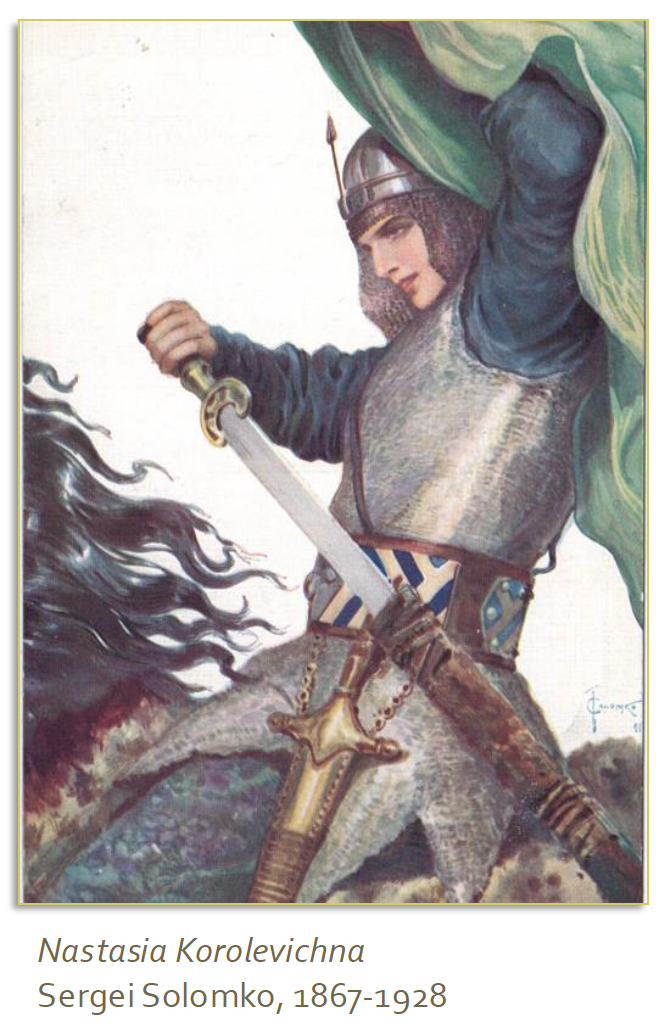
From ancient Greco-Roman literature through Russian folktales recorded in the last few centuries, the fate of most warrior women in heroic narratives is to die. While grieving the loss of her sister, Penthesilea led an elite band of Amazons to aid the defense of Troy against the invading Greeks. The fierce maidens cut down countless Greek soldiers, yet every single woman ultimately fell to a Greek arrow, spear, or sword. As the last Amazon standing, Penthesilea challenged Achilles to a duel. She failed, and so a false horse breached the gates of Troy. Centuries later, Vlasta led the Bohemian women in an uprising against a nascent patriarchy, but she was betrayed by one of her own. Surrounded by bloodthirsty men intent on revenge, Vlasta fell, and the maiden army she commanded fell with her. None of the warrior women survived the battle of the sexes that christened the Czech state. Further east near Kyiv, Nastasia Korolevichna acquiesced to marry the hero Dunai only after he narrowly defeated her in combat, thereby proving himself worthy of her hand. She later bested him in a public archery contest. Overcome with jealousy, Dunai killed first Nastasia and then himself.
These three women emerged from different time periods, cultures, and genres, but they exemplify a pattern often repeated in literary accounts of warlike, incontrollable, or otherwise transgressive women. They are also united by their geography, born in lands formerly held by the Scythians, a collection of nomadic tribes who dominated the Eurasian steppes from approximately the ninth century BCE through the third century CE. In literature from the Black to the Baltic Seas, from antiquity to the medieval period, those women who dared to challenge men, on and off the battlefield, were doomed to strive valiantly, to put on a grand show of near victory, and then to die spectacularly. Furthermore, warrior women do not stand alone in their narratives. They are cast as helpers, love interests, and enemies of the male protagonists. All we have of their narratives must be mined from the narratives of heroic men, against whom even the most extraordinary women are relegated to secondary roles.
Another pattern emerges, however, when we compare the more fantastical narratives in myths and folktales with the historical narratives in chronicles: fictional warrior women suffer worse fates than do the real ones. In literature, warrior women, no matter how successful in the short term, must eventually pay for their transgressions, namely, refusing to submit to men; whereas in history, warrior women can and often do remain victorious, defeating emperors, bringing multiple kings to heel, or laying siege to cities and setting their enemies ablaze before dying peacefully of old age. Thus, ancient and medieval representations of warrior women do not coincide with reality, a trend that sadly continues today with the distortion and erasure of narratives of female veterans and servicemembers in the US military. This dissertation aims to shed light on that erasure and distortion, past and present, and to restore warrior women to their rightful place in the center of their narratives.
Of the numerous motifs inherited from Ancient Greco-Roman literature, one subject enduringly dismissed as fiction is that of the Amazons. To societies entrenched in centuries of patriarchal norms prescribing proper womanly behavior, a matriarchal tribe of warrior women reads no less fantastical than a many-headed hydra or the convoluted voyage of Odysseus. Yet, the Amazons may not be as fictitious as scholars once concluded. Despite current US Secretary of Defense Pete Hegseth’s repeated assertions that women serving in combat is a recent development and is detrimental to military success, archaeological and anthropological efforts of recent decades have uncovered a plethora of material evidence that corroborates the existence of warrior women throughout the Bronze and Iron Ages, across a vast swath of territory corresponding to modern day Ukraine, Central Asia, and Russia. Moreover, the Greeks and Romans were not the only literate civilizations of millennia past to portray warrior women from the Eurasian steppes, nor were warrior women absent from the literature of the ensuing centuries. Medieval authors provide accounts of Viking Age warrior queens and shieldmaidens, or skjaldmeyjar, among both the Scandinavians and Slavs who came to populate the same territories the Greeks once attributed to the Amazons. Russian oral literature, which developed parallel to written traditions until its tales were recorded in the eighteenth through twentieth centuries, also depicts warrior women who lived and fought in a legendary version of medieval Rus’.
The suggestion that some facts may be buried among the ancient Amazon fictions has been gaining popularity thanks to recent archaeological discoveries. After extensive excavations of graves containing remains of women buried with weapons, many of whose skeletons bear the scars of battle, the conclusion that those women knew how to use their weapons is inevitable. An exclusively female society is as impractical as an exclusively male one, and so some scholars continue to reject the Amazons as sheer fantasy, but a relatively egalitarian society in which both men and women went to war hardly stretches the modern imagination. In fact, ample evidence—material as well as literary—supports the existence of such societies among the various tribes of Scythia. Given more than a thousand years of nomadic incursions into the territories of their sedentary neighbors, the contemporary consensus is that a real presence of warrior women among Eurasian steppe nomads inspired Ancient Greco-Roman authors to mythologize factual Scythians into fictional Amazons.[1]
Furthermore, the Amazons were not the only warrior women depicted in ancient literature. Alongside their more fantastical sisters, the narratives of several historical warrior queens also appear in the written record, and their combined narratives in turn provided subsequent literate civilizations with a template for documenting the curious phenomenon of warrior women, particularly those in positions of power. Medieval authors, classically educated and often writing in Latin regardless of their native tongue, drew inspiration from Greco-Roman models when describing extraordinary women. By examining medieval chronicles of Slavic and Scandinavian history, we can see the legacy of Amazons and Scythians among the Slavic queens and shieldmaidens of the Viking Age. Like their ancient predecessors, these warrior women were presented as “marvels,” as extreme exceptions to the norm: a handful of extraordinary women capable of rising above the failings of their gender.[2]
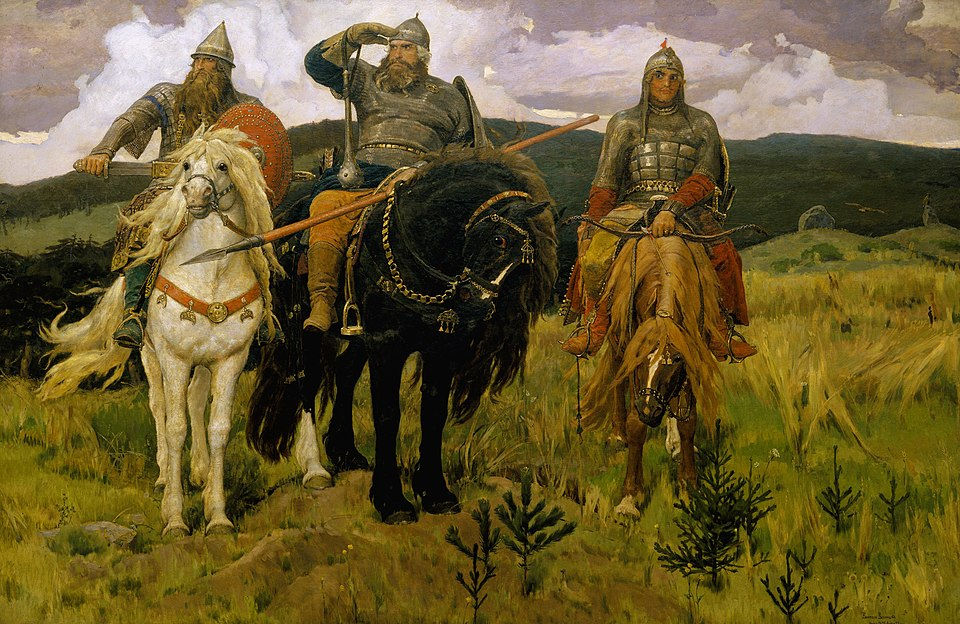
Developing alongside written traditions, Slavic folklore carried a parallel torch of ancient warrior women into the present age. Russian fairy tales and epic folk ballads depict the exploits of female warriors known as polianitsy who, like the Amazons before them, often dueled and sometimes wed famous heroes. Though a minority of Russian scholars have suggested a connection between the folkloric polianitsy and ancient steppe nomads, the polianitsy have not undergone nearly the same level of scholarly scrutiny as did ancient or medieval warrior women, nor have they been treated with the same level of seriousness as their male heroic counterparts, known as bogatyri.[3] The prospect that several bogatyri trace back to historical persons is generally accepted, yet the polianitsy are almost universally regarded as fictitious additions intended to amplify the heroic narrative, not as reflections of an earlier reality that allowed for women to bear arms. Nevertheless, hundreds of graves of armed women—and there are very likely many more female remains waiting to be properly gendered among the excavated burials of Scythian, Slavic, and Scandinavian origin—litter the landscape the polianitsy were said to roam.[4]
Citations:
1) D. Anthony, The Horse, the Wheel, and Language: How Bronze Age Riders from the Eurasian Steppes Shaped the Modern World (Princeton University Press, 2007): 329.
2) James Blythe, “Women in the Military: Scholastic Arguments and Medieval Images of Female Warriors,” History of Political Thought 22, no. 2 (2001): 246.
3) Tetiana Kaplun, “The Archetype of the Maiden Warrior in Eastern Slavic and German Musical Traditions,” Komitas Museum Institute Yearbook (2020): 307-308.
4) Adrienne Mayor, The Amazons: Lives & Legend of Warrior Women across the Ancient Worlds (Princeton University Press): 64.

Comments